


1. Old City
A moat-and-wall-enclosed square and its adjoining areas to the south and east. The architecture is mostly old and unremarkable — think budget guesthouses and hostels — and the residents are predominantly working-class Thais.
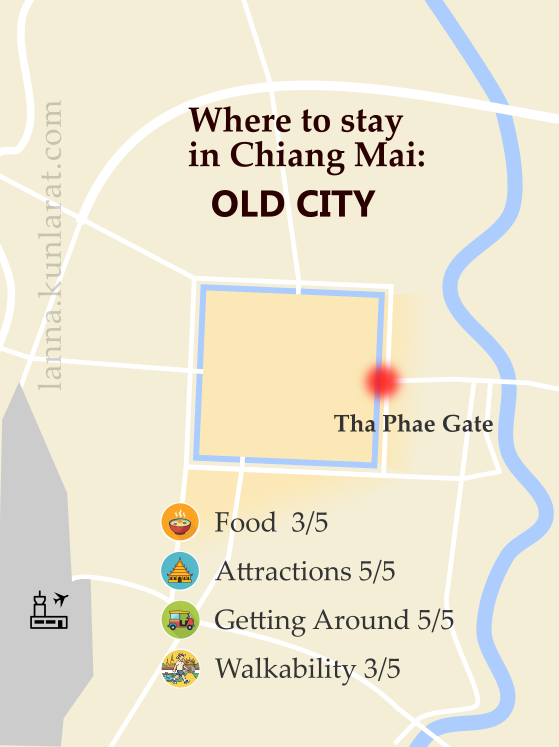
The nightly focal point: Tha Phae Gate (the eastern gate connecting to the Chang Khlan district, see #2)
Highlights: Home to Chiang Mai’s most important temples. In the mornings, the canal makes for a pleasant jogging route. On Saturday evenings, the street leading to Chiang Mai Gate transforms into a Night Market; on Sundays, the same happens along the street leading to Tha Phae Gate.
Downsides: Busy and noisy during the day, but things go quiet after 9 PM — except around Tha Phae Gate and a handful of other spots. Most visitors head to Chang Khlan for nightlife, or to the markets outside the northern and southern gates for Thai street food.
Best for: Backpackers and budget travelers without kids who are after an “authentic” slice of old Thailand.
2. Chang Khlan & the Night Bazaar
East of the Old City and stretching to the Ping River, this district was once a rough port neighborhood before reinventing itself as Chiang Mai’s main commercial, entertainment, and tourist hub.
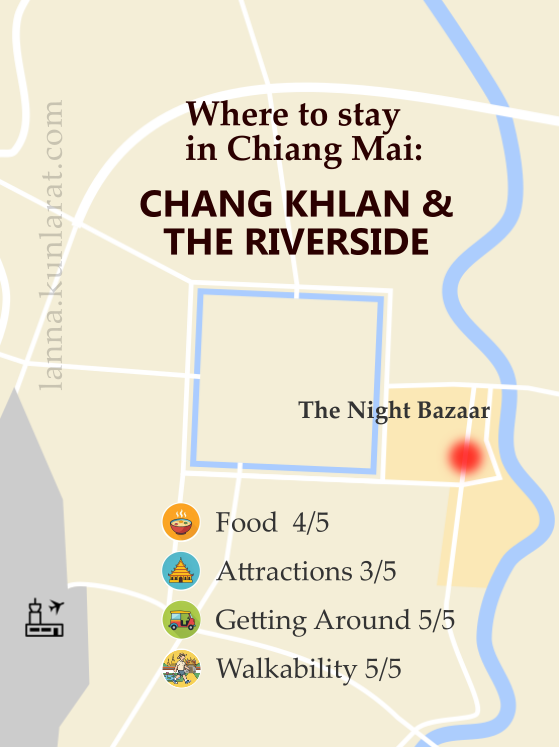
The nightly focal point: The northern stretch of Chang Khlan Road, which becomes The Night Market after dark, and the adjoining Soi Loi Kroh — the city’s bar and adult entertainment strip.
Highlights: A dense mix of large hotels, markets, restaurants, bars, massage parlors, and souvenir shops, plus the Ping River promenade, the Mae Kha Canal walking street, and other tourist draws. The area is walkable, including the stroll to and from Tha Phae Gate.
Downsides: The district feels a little tired — its pre-COVID heyday seems increasingly distant. Crowds are near-constant, and prices run high for food and goods that are often mediocre quality.
Best for: Classic tourists — the ones tuk-tuk drivers and Elephant Pants vendors have in mind. Families who need the amenities of large hotel complexes. Muslim travelers (the city’s mosques are here) and the Israeli community (this is their social hub).
3. Nimman
West of the Old City and separated from it by a large hospital complex, Nimman has the highest concentration of upscale condominiums, boutiques, galleries, gyms, and trendy bars and restaurants in the city.
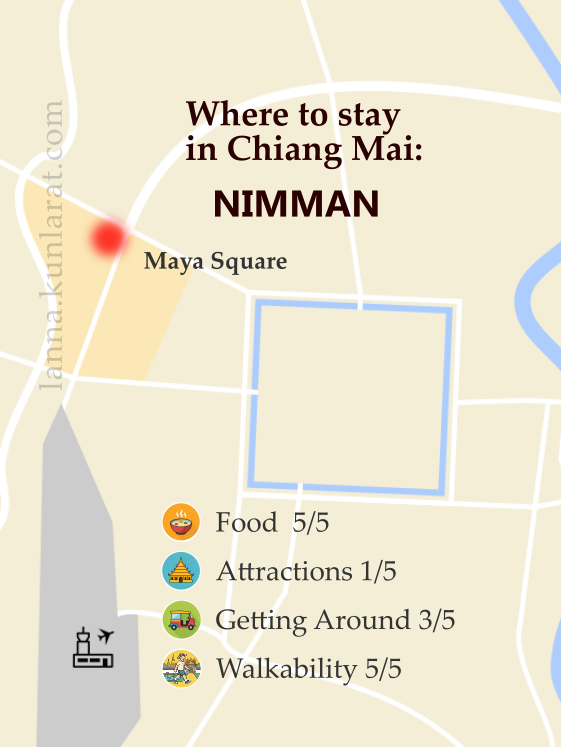
The nightly focal point: The plaza between Maya and One Nimman shopping malls, at the top of Nimmanahaeminda Road.
Highlights: A comparatively modern, stylish, and well-kept neighborhood that’s genuinely pleasant to spend time in.
Downsides: Expensive. Cramped — the area was never designed for this density of businesses and foot traffic. The surrounding roads, especially the intersection in front of Maya Mall, are the worst traffic bottlenecks in the city. And planes taking off overhead are a constant background presence.
Best for: Thai “HiSo” weekenders from Bangkok, well-heeled tourists, expats from China, Taiwan, and Korea, and digital nomads from just about everywhere.
4. Suthep
The westernmost district, set in the foothills of Doi Suthep mountain along the edge of the national park that shares its name. The campus of Chiang Mai University dominates the area and draws a large student population, which means affordable apartments, interesting cafés, cheap eats, and laid-back hangouts. At the same time, the zone bordering the park carries real prestige — forested hillsides are dotted with upscale villas and boutique hotels. Evenings here are genuinely quiet.
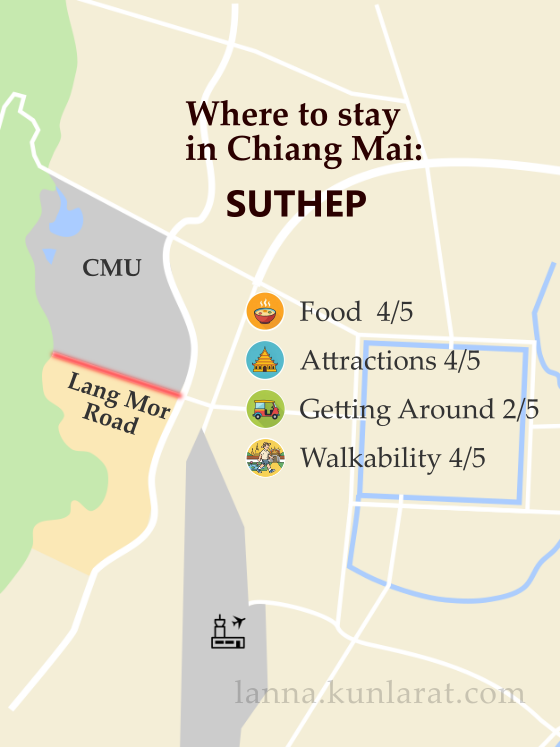
The nightly focal point: Lang Mor Road, which runs along the southern edge of campus. An evening market sets up here nightly, widely considered to have the best and most affordable street food in the city. The walking and jogging path around Angkaew Reservoir on campus — with its benches and open grassy areas — is also a favorite local retreat, and entry is free.
Highlights: An intellectual, and at times genuinely creative, low-key atmosphere. Several popular hiking trails into Doi Suthep National Park begin here. Bike-friendly streets.
Downsides: A fair distance from the city center.
Best for: Those staying for a longer stretch, who want to sidestep tourist bustle and aren’t interested in nightlife — but love good cafés and easy access to nature.
5. Santitham & Jed Yod
Two similar neighborhoods north of Nimman, divided by a wide multi-lane highway. Jed Yod is farther from the center and has a somewhat quieter, more residential feel. Both areas got their boost when Nimman rents became prohibitive, prompting mid-range businesses and their budget-conscious expat clientele to migrate here. The result is neighborhoods that are reliably “middle of the road” in the best sense: better infrastructure than the Old City, cheaper than Nimman, less touristy than Chang Khlan, and closer in than Suthep.
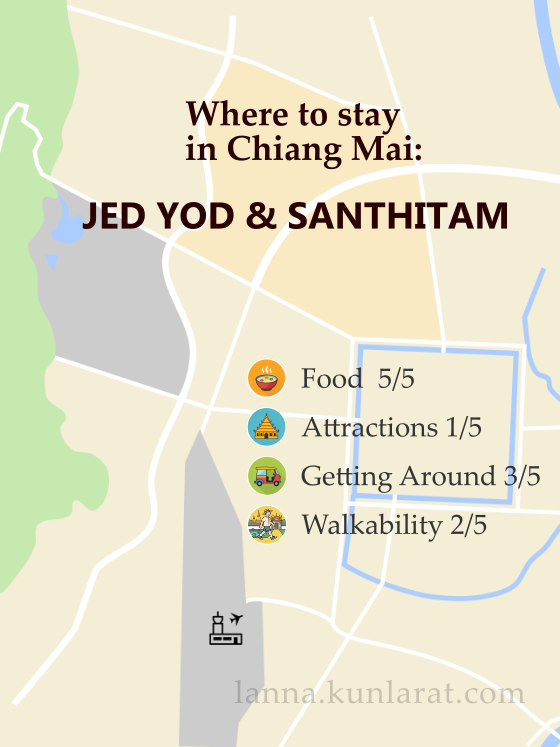
The nightly focal points: Santitham Road and Jed Yod–Chang Khian Road that come alive as open-air food courts each evening.
Highlights: A solid selection of affordable, decent-quality restaurants, bars, and serviced apartments catering to foreigners. Thanks to its low rents and entrepreneurial energy, Santitham leads the city in sheer variety of small independent restaurants spanning cuisines from around the world.
Downsides: Neither neighborhood has the distinct character or atmosphere of the others on this list.
Best for: Expats and independent travelers who get around on their own wheels and want value without sacrificing comfort.
While Chiang Mai is a sprawling city offering accommodation for every budget in almost every corner, these five districts stand out for their high density of short-term rentals and traveler-oriented infrastructure. In other parts of town, you might step out of your hotel only to find yourself in the middle of a vast residential area with few dining options beyond basic local stalls. In such areas, even catching a Grab can be a long wait, making these five zones the most reliable ‘hubs’ for a hassle-free stay.